Asset Record Shop · clothing retail
Where every garment is, what state it is in and who moved it
Every garment has a record in the shop database: store, display, stockroom or tailor, sold or delivered, with the history of operations by operator and date. Incoming goods are checked against the delivery note and the availability of an article is shown by store. The QR label opens the record from a phone; from a computer all garments can be searched and the data exported.
Request a presentation Features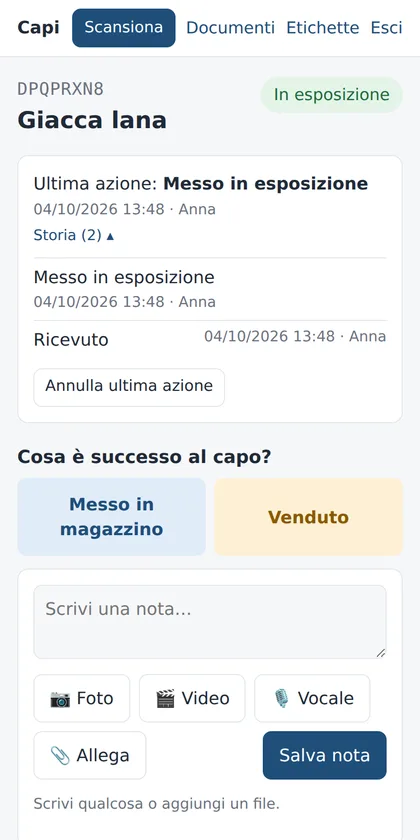
Who it is for
Asset Record Shop fits if you:
- sell garments from one or more brands, in one or more stores, and want to know where each single garment is, not just how many you have;
- check incoming goods against the supplier's delivery note or invoice;
- have garments that go through tailoring or stay in the store sold, waiting for collection;
- want a history of operations with operator and date instead of spreadsheets and manual checks.
It does not replace a till, e-commerce or accounting system: the data is exported as CSV.
How it works
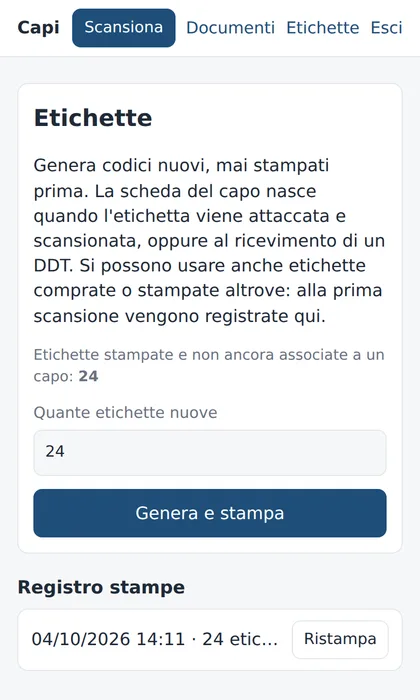
- Label. New QR codes are printed from the application, or labels printed elsewhere are used. The code is registered at the first scan.
- Scan. Any phone camera works: the QR contains the address of the record. No app to install.
- Record. Item data, state, notes, photos, videos and voice messages. Every operation stays in the history with operator, date and time.
Features
Goods receiving
The supplier's delivery note or invoice is uploaded as PDF or photo; lines are read with AI, optional, or entered by hand. At receiving, each scanned garment is matched against the document lines: missing, extra, quantity differences.
Availability across stores
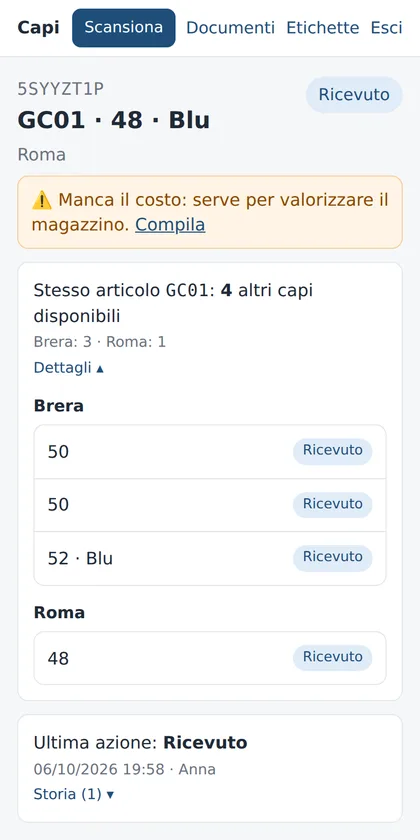
From a garment's record, the other available garments of the same article are listed by store, with size and colour. Moving a garment to another store is a change of store, recorded in its history.
States and actions
In stock, at the tailor, delivered, returned. Allowed transitions are defined and each action asks for confirmation. Sold and on display are recorded separately: a sold garment can still be at the tailor.
Garment record
Description, supplier article code, size, colour, store, cost and price. Written notes, photos, short videos and voice notes recorded in the browser.
Labels
Generation of never-used codes, printing on 40×30 mm labels or A4 sheets, print log to avoid duplicate codes and accidental reprints.
Exportable data
Full CSV export at any time and a read-only JSON API to connect other systems. The data belongs to the customer.
Use in the shop
Each operation requires scanning the garment and choosing the action. The record offers only the actions allowed in the current state and asks for confirmation before recording them. The last recorded action can be undone.
If cost or price are missing on a sold garment, the record shows a warning; the fields remain optional.
Works on phone, tablet and computer, in any recent browser.
A trial on a few garments from your store: labelling, receiving against the delivery note, moves and availability across stores.
Ask for a trialDigital Product Passport
The EU Ecodesign for Sustainable Products Regulation (ESPR) introduces the Digital Product Passport: information on origin, composition and life cycle, reachable from an identifier on the product. Textiles are among the first sectors concerned.
A unique identifier per item and a record with structured data are the basis for it, reusing data collected in day-to-day operations.
Configuration
Each customer has a separate instance, with its own data, users and stores. For different processes, such as in-house tailoring or an outlet, fields and states are adapted on a project basis. Adoption starts with a pilot on one store and a sample of garments.
For ateliers that also make their own garments there is Asset Record Atelier, with materials stock and production cost.
Request a presentation
A dedicated session to see, on your own case, how a garment is labelled, a delivery is checked against its note and availability across stores is looked up, with a sample of labels.
Write to info@ekatekai.com