Asset Record Atelier · ateliers and tailoring workshops
The cost of every garment, calculated from fabric, hours and outsourced work
Every garment and every fabric roll or pack of trims has a QR label and a record. During production the materials used, cutting and sewing hours and outsourced work are recorded: the material stock goes down and the cost of the garment is calculated, split into materials, hours and outsourced work. Garments, fabrics and trims are in the same register; for sales, tailoring and goods receiving it works like Asset Record Shop.
Request a presentation What it does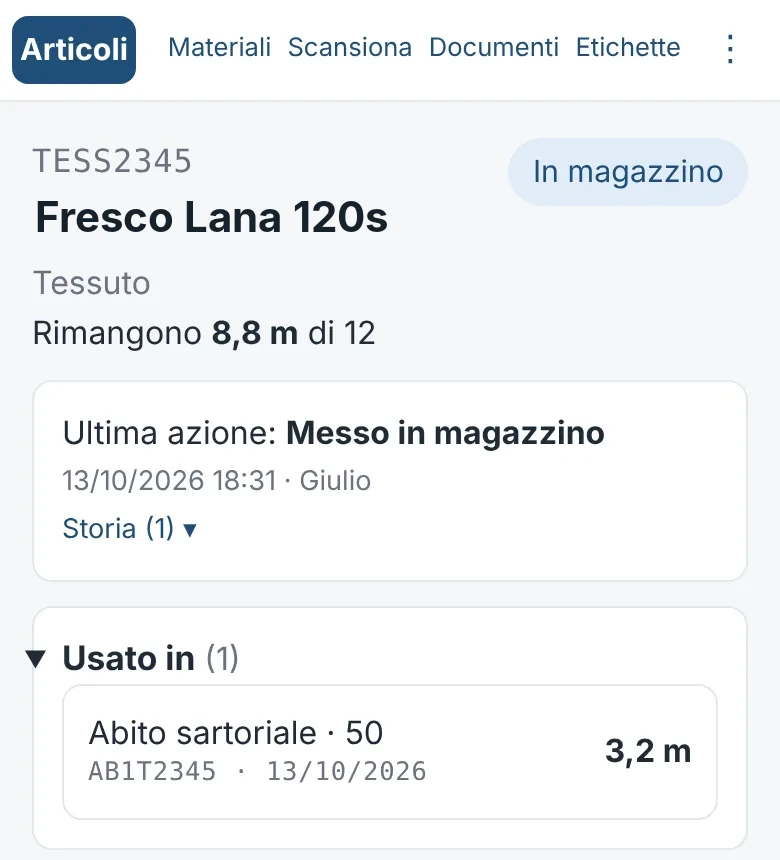
Who it is for
Asset Record Atelier fits if you:
- make garments in your workshop, made to measure or in small runs, and want to know what each one costs;
- keep fabrics and trims in stock and want to know how much is left and which garments used it;
- do alterations and want to compare their cost with the price charged to the customer;
- also sell garments from other brands, to be managed in the same register.
It is meant for small ateliers and workshops, not as a replacement for a production planning system: the limits are under Current scope.
Three kinds of object, one register
The first time a new label is scanned, the application asks what it identifies.
- Item. A finished garment bought from another brand: received, displayed, sold and sent to tailoring as in Shop.
- Garment to produce. Made in the workshop; it stays "In production" until it is ready.
- Material. A fabric roll or a pack of trims: one label per roll or pack, with the initial quantity in metres or pieces.
Features
Receiving garments and materials
The supplier's delivery note or invoice is uploaded as PDF or photo; lines are read with AI, optional, or entered by hand. Each piece received is scanned and matched to its line; for a material the quantity is entered and the line price becomes the unit cost. The comparison flags missing and extra items.
Materials stock
A separate list shows fabrics and trims with what is left, for example 6.5 m of 12. The quantity goes down with each use; at zero the material is marked as used up. A material's record shows which garments it went into, when and how much.
Production
On the garment's record the materials used are added by scanning the roll's label and entering the quantity, together with cutting and sewing hours and the cost of outsourced work. With "Ready" the garment goes into stock and is handled like any other piece.
Garment cost
Materials times unit cost, cutting and sewing hours times the atelier's hourly rates, plus outsourced work. It updates when any value changes and is visible to administrators only.
Tailoring
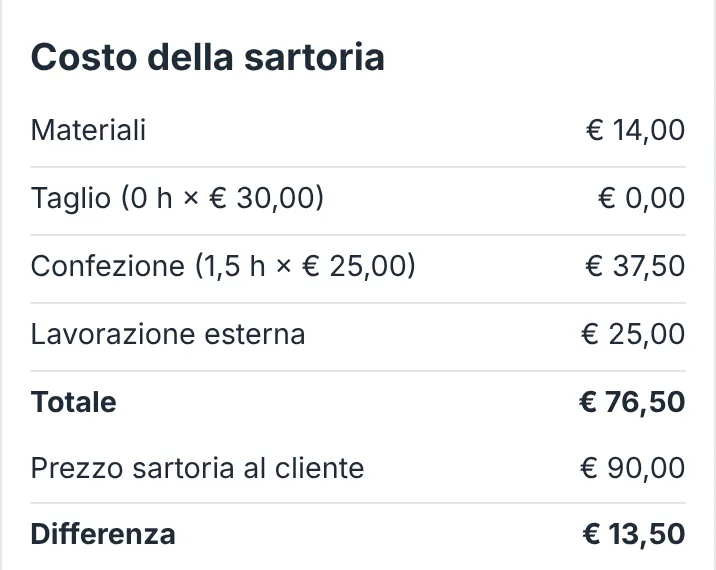
For an alteration on a bought or produced garment, materials, hours and outsourced work are recorded the same way. The tailoring cost is kept separate from the garment cost and compared with the price charged to the customer.
Exportable data
Separate CSV exports for items, materials with remaining stock, and material usage (which material, in which garment, at which stage, how much). Read-only JSON API for a single record.
Example calculation
The garment cost is the sum of three parts: materials at their unit cost, cutting and sewing hours at the atelier's hourly rates, outsourced work. It is updated when any of the values changes.
The result is as accurate as the quantities and hours recorded. For this reason materials are recorded by scanning the roll used, and every entry stays in the garment's history with operator and date.
garment  made-to-measure wool jacket

materials
 wool fabric   3.2 m × 28.00 €     89.60 €
 lining        1.8 m ×  9.50 €     17.10 €
 buttons       6 pcs ×  1.20 €      7.20 €
hours
 cutting       2.5 h × 30.00 €     75.00 €
 sewing       14.0 h × 25.00 €    350.00 €
outsourced work
 buttonholes                       18.00 €

garment cost                     556.90 €
The cost of an alteration
Alterations are often quoted from memory. Recording materials, hours and outsourced work for tailoring too, the record shows the actual cost of the alteration next to the price charged to the customer and the difference between the two.
The tailoring cost is visible to all staff, because whoever prepares the quote needs it; the production cost of the garment stays restricted to administrators.
A trial on one garment and a few fabric rolls from your workshop: materials, hours and calculated cost.
Ask for a trialData visibility
| Cost of a produced garment | Administrators only |
|---|---|
| Cost of a bought garment, unit cost of materials | Administrators and whoever entered it |
| Tailoring cost and price, sale price | All staff |
A typical flow
- A parcel arrives with fabrics and finished garments. The delivery note is uploaded, every roll and garment is labelled and matched to its line.
- A garment is started: new label, "Garment to produce".
- In the workshop the rolls used are scanned with their quantities and the hours are entered. Materials stock goes down and the garment cost is calculated.
- The garment is finished: "Ready". It goes into stock and on display.
- A customer buys it and asks for a hem: sold, sent to tailoring, with materials, hours or outside workshop recorded.
- Delivery. The whole history stays on the record, with operator and date of every step.
Current scope
Production is tracked per garment, with two states: in production and ready. There are no bills of materials, semi-finished goods or stage planning, and no point of sale or e-commerce: data is exported as CSV. Users have two roles, administrator and user.
The materials used stay linked to each garment: part of the data the Digital Product Passport will need.
Request a presentation
A dedicated session to try the tool on one garment and a few fabric rolls, with a sample of labels.
Write to info@ekatekai.com